


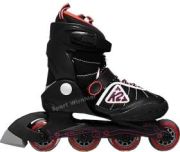
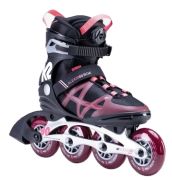
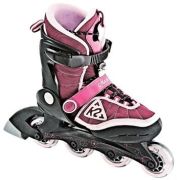

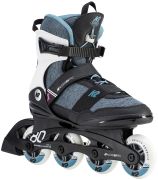





Newly Added Products

Buy inline skates cheaply: consumer tips
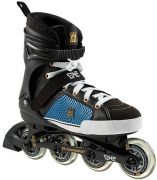
In terms of shoe construction, a distinction is made between models with an outer hard shell and inner shoe, known as hardboots, and models with only a soft shoe, known as softboots. Hardboots provide more support compared to softboots and are particularly common in the aggressive and stunt areas of inline skating. However, they are not as comfortable as softboots. In these, fabric essentially serves to support and cushion the foot. This also ensures better ventilation than with hardboots. Buckles or lacing serve as closure systems for both hard- and softboots. A combination of both is also possible.
What differences should be noted?
First, a distinction is made in the way of skating, namely fitness skates, speed skates, street or aggressive skates, and off-road skates. Fitness skates, sometimes also called fun, recreational, or leisure skates, make up the largest group. They are often the preferred choice for beginners, as they offer both high comfort when worn and allow for relatively fast skating. Within the price groups, they mainly differ in comfort, workmanship, and equipment with higher quality components, such as better wheels and bearings. Special hockey skates look most similar to fitness skates, but despite their high durability, they are agile and fast and usually do not have a brake. Speed skates allow for higher speeds due to their design (longer aluminium frames) and are used in racing. The shoe only reaches up to the ankle, providing greater mobility in the ankle area. Speed skates do not have a brake. Street or aggressive skates are particularly durable and specifically designed for "harder", more demanding skating, such as jumps, halfpipes, ramps, slides, slalom, stair skating, and similar styles. The wheels are arranged in a high-low system (different diameters) to allow for better grinding. Also, so-called soul plates (relatively large, reinforced areas on both sides next to the frame) increase the variety of tricks. Street or aggressive skates are usually delivered without brakes. A special feature is off-road skates, which can also be used on park paths and lawns. This is made possible by particularly large wheels. Skates are often used with poles (Nordic blading).
Wheels and bearings
With smaller wheels, you generally accelerate better and they also provide more agility, while larger wheels excel in speed and are easier to ride over long distances. Fitness wheels have a diameter of 72 to 80 mm and taper to minimise the contact area with the ground, resulting in less friction and allowing for higher speeds. Street or aggressive wheels usually have smaller so-called flat-top wheels (41-66 mm), which provide a wide contact surface. They allow for better manoeuvrability, but you cannot go as fast. Their flat shape enables a secure stance, for example, after jumps. Speed skaters use particularly large wheels (approximately 80-110 mm in diameter), which allow for high speeds but come with limitations in agility. Furthermore, the longer frames accommodate four wheels. The hardness of the wheels is usually indicated on the Shore A scale. For inline skates, wheels ranging from 72A (soft) to 100A (hard) are common. Examples: fitness wheels 78A to 85A, street or aggressive wheels 85A to 100A, and speed wheels 82A to 90A. Bearings are used to mount the wheels on the axles and minimise friction, allowing for smooth gliding. Inline skates typically use bearings rated ABEC 1, 3, or 5. The higher the ABEC rating, the more precise the manufacturing tolerances were adhered to during production. However, this classification has only limited usefulness for use as skate bearings.
What should you pay attention to when buying?
In general, fit should be the priority when purchasing! Try on the skates preferably in the afternoon, as feet tend to swell slightly throughout the day. Some models run small. If in doubt, opt for a size larger. When trying them on, wear thin socks to identify pressure points. Skates do not give. If the shoe is tight during the fitting, it will be tight later as well. There should be an insole in the shoe, the heel must fit snugly and should not have any play. The easier you can slip into the skates, the better. Make a conscious choice regarding the lacing system: traditional laces (the shoe adapts better to the foot and provides good support) or buckles (faster to close and open). In addition to unisex models, also try special designs for women and men. As a beginner, you should choose soft wheels (hardness less than 78A) as they provide more grip and can better overcome uneven surfaces. However, the downside is that soft wheels require more effort. For high speeds, hard wheels with less grip and cushioning are suitable. Before purchasing, inform yourself about the maximum usable wheel size to avoid disappointment later if you want to upgrade when you skate faster. For bearings, a lower ABEC rating is sufficient for beginners. New and better bearings can be purchased later if needed. Changing bearings and wheels is, if you skate a lot, inevitable sooner or later. For later braking, ensure that the braking angle is comfortable. And ultimately, you should already think about purchasing protectors (wrists, elbows, knees) and a helmet when buying inline skates.