




























Newly Added Products






Buy tennis products cheaply: consumer tips

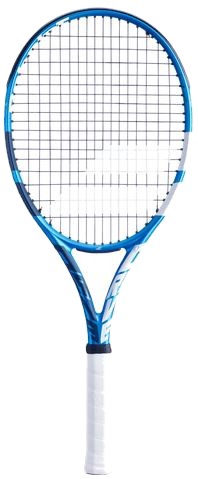
The power of a racket is determined by the frame thickness and frame stiffness: the harder the frame, the more kinetic energy it can return to the ball. Strings are strung into the frame in a checkerboard pattern – the hitting surface. If the hitting surface is large, the so-called sweet spot, the area with the least impact shock and vibrations, is also larger. The grip size of a tennis racket is important, as the fingers must optimally wrap around the grip to prevent the hand from tiring too quickly.
What are the differences between tennis rackets?
Tennis rackets are classified into four different head sizes: Midsize (MS, area up to approx. 630 cm²), Midsize Plus (MSP, area of approx. 630 - 675 cm²), Oversize (OS, area of approx. 650 - 740 cm²), Oversize Plus (OSP, area of over 700 cm²). Since smaller head sizes allow for better ball control, many professional players use these variants. Rackets with very large surfaces usually have a lot of power and are therefore ideal for inexperienced players who cannot generate their hitting power from a long backswing. Most tennis rackets have 18 main strings and up to 21 cross strings. With fewer main strings, the racket has more spin, while more strings provide more precision. Regarding string tension: the harder the racket is strung, the more ball control you have, but the less power you have in your shot. Racket grips come in several shapes and sizes. The grip tape wrapped around the grip handle conforms to the hand and absorbs sweat. There are a total of seven different grip sizes: L 1: 105 mm = 4 1/8 inches, L 2: 108 mm = 4 1/4 inches, L 3: 111 mm = 4 3/8 inches, L 4: 114 mm = 4 1/2 inches, L 5: 118 mm = 4 5/8 inches, L 6: 121 mm = 4 3/4 inches, L 7: 124 mm = 4 7/8 inches. The weight of a tennis racket allows a larger mass to sit more steadily in the hand, making it easier to play high balls. However, this can compromise manoeuvrability. The standard length of a tennis racket is approximately 68.5 cm. However, there are also 'rackets' in extended lengths (up to 71.5 cm).
What should be considered when buying?
Significant differences in frame shapes are not known, so there is no need to think too much about this. The grip is more important: it should neither be too thin nor too thick. When holding it, the space between the little finger and the palm should be about finger-width. If you additionally wrap an overgrip over the base grip, which absorbs moisture, it may be advisable to choose a grip one size smaller. As a general rule of thumb, the following could apply: a smaller racket head has less power, a smaller sweet spot, but higher precision. A thinner frame has less power, less precision, but better length control. A lighter frame also has less power, requires less strength, and flutters relatively quickly. A head-heavy racket also has less power but is more manoeuvrable. To minimise health risks, the racket should not be too heavy or head-heavy, the materials should be vibration-dampening, and the string tension should match your playing strength and the training condition of your arm muscles. As a beginner, one should prefer a string tension that is not too hard. Natural gut or high-quality synthetic strings are more elastic, dampen vibrations better, and thus protect the arm and shoulder. A tennis racket should be replaced after a maximum of 5 years or after approximately 100 new stringings.