













Bicycle inner tubes: Consumer tips
Bicycle inner tubes are crucial for the performance and durability of a bicycle tyre. They come in various sizes, materials, and valve types. To find the right bicycle inner tube, the tyre size, valve, material, and quality of the tube must be considered. This article explains some important aspects that can help in selecting the ideal bicycle inner tube.
What is a bicycle inner tube?
A bicycle inner tube is a flexible, ring-shaped tube made of rubber or another elastic material, placed inside the tyre of the bicycle. The tube is equipped with a valve through which air can be added or released. The purpose of the bicycle inner tube is to hold air, which inflates the tyre and provides cushioning, traction, and riding comfort. Bicycle inner tubes are available in various sizes and materials to accommodate different tyre and bicycle types. The size of the tube should match the size of the tyre to ensure proper fit and function. The valve types most commonly used in bicycle inner tubes are the Presta valve and the Schrader valve. Both have their own advantages and disadvantages and are chosen depending on the type of bicycle and personal preferences.
What materials are bicycle inner tubes made of?
Bicycle inner tubes are primarily made from butyl rubber and latex. Butyl rubber is the most commonly used material as it is durable, long-lasting, and cost-effective. Butyl rubber tubes offer good puncture protection and maintain their shape and elasticity over a long period. Latex, on the other hand, is a lighter and more flexible material often used in tubes for performance-oriented racing bikes and mountain bikes. Latex tubes provide better rolling characteristics and lower rolling resistance but are more prone to punctures and lose air faster than butyl rubber. Additionally, Schwalbe, Continental, Pirelli, and other manufacturers process additional materials to further enhance performance.
Which bicycle inner tube do I need?
The size of a bicycle inner tube depends on the size of the tyre. The tyre size is usually indicated on the side of the tyre and consists of two numbers, e.g., 700x23c for the French notation or 26x1.95 for the English notation and 22-622 for the standardised European ETRTO notation. The first number indicates the diameter of the tyre in millimetres or inches, while the second number indicates the width of the tyre.
- Racing bikes use narrower tyres and tubes. Common tube sizes are 700x18C to 700x28C. These sizes are given in millimetres (diameter x width) and refer to the 700 mm diameter and width of the tyre. Presta valves are often preferred for racing bikes as they have the appropriate valve lengths for hollow rim profiles.
- Mountain bikes typically have wider tyres for better traction and stability on uneven terrain. Common tube sizes for mountain bikes are 26x1.75 to 26x2.5 inches or 27.5x1.75 to 27.5x2.5 inches for 27.5-inch wheels (also called 650B) and 29x1.75 to 29x2.5 inches for 29-inch wheels (also called 700C). Mountain bikes mostly use Schrader valves, but Presta valves are also used.
- Trekking/Touring bikes use medium-width tyres and tubes to provide a good mix of comfort, speed, and stability. Common tube sizes for trekking bikes are 700x32C to 700x45C or 26x1.5 to 26x2.0 inches. Both valve types, Presta and Schrader, are common here.
- City bikes generally have wider tubes to provide additional comfort and stability on urban roads and bike paths. Common sizes are 26x1.5 to 26x2.5 inches or 700x35C to 700x45C. Again, both valve types are common.
- BMX bikes typically use 20-inch wheels with wide tyres for stability and shock absorption. Common tube sizes for BMX bikes are 20x1.75 to 20x2.5 inches. Schrader valves are most commonly found in the BMX scene.
When purchasing a bicycle inner tube, it is important to check the size of the tyres and tubes recommended for the specific bicycle and to select the correct tube size accordingly. The tyre and tube size is usually printed on the sidewall of the tyre.
What different valves are there?
There are three main types of tyre valves used in bicycle inner tubes: Schrader, Presta, and Dunlop valves. The choice of the right valve depends on the type of bicycle and the rims, and since each of the valves has its own advantages and disadvantages, it is not possible to determine a universally best bicycle valve.
- Also known as car valves, Schrader valves are commonly found on mountain bikes and city bikes. They have a larger diameter than Presta or Dunlop valves and are equipped with a check ball that prevents air from escaping. It is a type of valve for bicycle tyres that can be inflated at petrol stations, which is particularly advantageous if you have a flat tyre while on the go. Due to its wide design, it is very stable and can be inflated up to 10 bar. It should be noted that not every pump is compatible with this type of valve.
- The Sclaverand- or Presta valve is a French valve commonly used on racing bikes and can also be used on trekking bikes and mountain bikes. It withstands high air pressure of up to 15 bar and allows for precise pressure adjustment. The narrow design offers greater rim stability, which is particularly important for racing bikes and high-quality mountain bikes. A disadvantage of the Presta valve is its susceptibility to deformation due to its narrow design. They have an integrated valve core that must be loosened for inflation. Presta valves offer low air loss but require a special pump or an adapter.
- Less common is the Dunlop- or Blitz valve. However, it is still used on some city bikes and especially on Dutch bikes. They resemble Presta valves but are less sensitive and can be inflated with a standard pump. Dunlop valves are durable and straightforward, but can only be inflated up to 6 bar, which is sufficient for most city bikes. Those looking for a valve that is easy to maintain should choose this one.
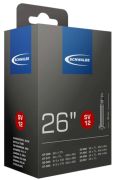
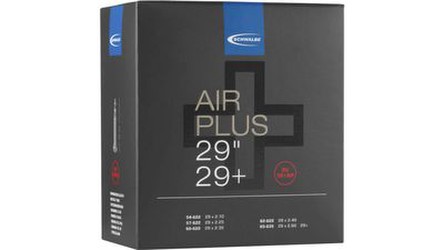
It is important to note that a tube is always only compatible with one type of valve. You cannot simply interchange the valves; in the case of a defect, you must buy a new bicycle inner tube. Abbreviations have been established for the valves, which are printed on the packaging of the tube. The abbreviation for the Sclaverand valve is SV, for the Dunlop valve DV, and for the Schrader valve AV.
Are there bicycle inner tubes with puncture protection?
Punctures are among the most unpleasant experiences when cycling. Fortunately, there are various ways to reduce the risk of a puncture. One option is bicycle inner tubes with integrated puncture protection. These tubes are more robust and resistant to punctures and tears. They are made from thicker material or have an additional protective layer to shield the tube from sharp objects and rough surfaces. Self-repairing tubes contain a special sealing agent inside that flows out when there is a hole or a small tear and quickly seals the damage. This allows for minor punctures to be practically fixed immediately without needing to replace or patch the tube. If you do have a flat while out, a puncture spray can help quickly. The spray is applied to the tube valve, and the entire contents are emptied. After that, the tyre is turned several times to ensure the sealing liquid spreads optimally. The tyre is then fully inflated again, sealing the hole.
More tips for selecting the right bicycle inner tube
A lightweight tube can improve riding performance, especially on racing bikes and lightweight mountain bikes. However, a lightweight tube is often less puncture-resistant than a heavier one. When selecting a bicycle inner tube, attention should be paid to quality. High-quality tubes offer better durability and puncture protection. Brands like Schwalbe, Continental, or Michelin are known for their high-quality bicycle inner tubes. It is advisable to always carry a spare tube and a repair kit to respond quickly and easily in the event of a puncture. Some cyclists prefer CO₂ pumps to quickly inflate the spare tube. In summary, the choice of the right bicycle inner tube depends on various factors. It is important to pay attention to size, material, valve, and puncture protection to find the ideal tube for your bicycle. High-quality bicycle inner tubes significantly contribute to a pleasant, safe, and high-performance cycling experience.