









Buy a mountain bike: consumer tips

A mountain bike, also known as MTB, is a particularly versatile bicycle that excels on unpaved paths in the mountains. They offer an optimal mix of off-road capability, speed, and riding comfort. To find the right mountain bike, one should consider various factors such as frame material, suspension, geometry, and tyre size. Below, we highlight some important aspects that can help in the search for the ideal mountain bike.
What characterises a mountain bike?
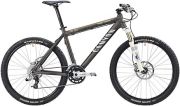
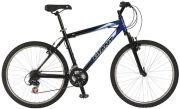
A mountain bike is a bicycle specifically developed for riding off-road. The mountain bike originated in the 1970s in California out of the need to ride on difficult trails and off paved roads. It allows riding on gravel roads, field paths, and mountain trails away from asphalted roads. Over time, the mountain bike has evolved into a bicycle used in various disciplines such as cross-country, downhill, all-mountain, and enduro. Cross-country involves riding on natural and artificial tracks with a mix of technical sections and steep climbs. In contrast, downhill focuses on riding in steep and technically demanding terrain at high speeds. Another feature of mountain bikes is their robust and durable construction, which allows them to withstand falls and hard landings. The frames are typically made of aluminium or carbon, but steel and titanium are also used. Additionally, disc brakes, wide handlebars, and suspension forks enhance off-road capability. Mountain bikes have gear systems with many gears, allowing the gearing to be precisely matched to the trail conditions. Today, there is a wide range of mountain bikes available on the market, including hardtails with front suspension only and full-suspension bikes (fullys) with both front and rear suspension.
Hardtail or fully - how much suspension do you need?
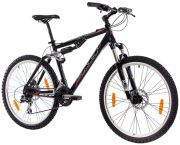
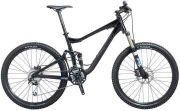
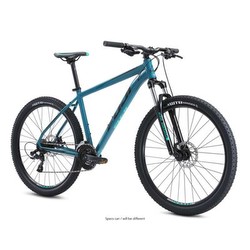
Whether to choose a hardtail with a suspension fork or a fully suspended bike mainly depends on the intended use. The better a mountain bike is suspended, the more comfort, stability, and control it offers even in very demanding terrain. Obstacles can be crossed without significant jolts, unlike a hardtail. This allows for high speeds on single trails and downhill tracks. Those who want to have fun on established courses and are not afraid of jumps definitely need the full suspension of a fully. Disadvantages include the higher weight, increased maintenance of the components, and the significantly higher purchase price. Hardtails are designed for less demanding trails and are also very suitable as all-weather bikes in the city. The lower weight and attractive price make the hardtail MTB a good all-rounder. Those who are ambitious with the fully should have a back protector and the corresponding protective gear.
What equipment do mountain bikes have?
A mountain bike is a sporty bicycle for fast and demanding rides off-road. Its functions and features are specifically tailored to the requirements of rough terrain. Below are some typical equipment features of a mountain bike.
- The suspension fork is offered with various travel lengths. Depending on the terrain requirements, an adapted travel length is recommended to optimally absorb unevenness. Some suspension forks can also be locked (lock-out) to improve power transfer during climbing and on flat sections.
- For the gear system, a chain drive from Shimano or SRAM is used, which allows for a wide gear range. In the enduro and cross-country areas, single chainrings are often used to save weight. However, most mountain bikes are equipped with double or triple chainrings that offer an even larger gear range.
- For the tyres, knobby tyres between 2 and 2.5 inches are used to ensure the best possible grip and traction. Plus tyres for fat bikes are available up to 5 inches and are ideal for snow and sand.
- Hydraulic disc brakes are now standard on mountain bikes and provide optimal braking performance and very precise modulation even during fast descents. Although they require slightly more maintenance than rim brakes, they have become established in recent years.
- The wheels of modern mountain bikes are typically 27.5 inches (also known as 650B) or 29 inches in size. Both sizes offer high riding comfort on uneven terrain and are agile and manoeuvrable. 26-inch wheels are now only found on dirt jump and fat bikes or on inexpensive entry-level models.
- The handlebar of a mountain bike is usually wider than that of conventional bicycles. The wider the handlebar, the more pressure can be applied to it, and the better the steering movements can be controlled.
Carbon or aluminium - which frame material for a mountain bike?
Most mountain bike frames in the lower to mid-price range are made of aluminium. It is very light, torsionally stiff, and weather-resistant, but does not offer good damping properties and rides correspondingly hard. High-quality models use carbon as the frame material. It is even lighter and stiffer than aluminium and offers high riding comfort due to good vibration damping. The major disadvantage of carbon is that invisible damage can occur in the event of a fall or accident. Even if the mountain bike slips from your hand and falls to the ground, it may mean that the frame is damaged and needs to be replaced. In addition to carbon and aluminium, steel is still used in gravel and bikepacking bikes due to its high riding comfort. High-quality CroMo steel is light and corrosion-resistant. Titanium is also used for its weather resistance and durability in very expensive bicycles. However, these are usually from smaller manufacturers with a limited model variety.
How do the wheel sizes differ in mountain bikes?
- Wheels with 26 inches are very agile and were long the standard size for mountain bikes, but they roll less well over obstacles. Therefore, they are no longer found in high-quality models today. They are still used on dirt jump or children's and youth bikes.
- Wheels with 27.5 inches are the most common wheel size for mountain bikes. They offer very good stability and acceleration. They are particularly popular in the freeride and enduro areas, where a particularly torsionally stiff wheel is required.
- Wheels with 29 inches offer the best rollover properties and thus the highest comfort on uneven trails. Although acceleration with 29-inch wheels requires a bit more effort, the higher speeds and smoothness are significant advantages over smaller sizes.