






Food Slicers: Consumer tips

When comparing slicers, prioritise safety, blade quality, slice-thickness adjustment and easy cleaning. Also consider how often you will use the machine: a compact model may suit occasional slicing, while a heavier-duty metal slicer is better for regular use.
Blade type and slicing performance
The blade is the most important part of a food slicer. Many models use a circular stainless-steel blade, often around 17cm to 19cm in diameter. Larger blades can accommodate bigger loaves and wider cuts of food, while compact slicers are easier to store.
A smooth-edged blade is generally best for cheese, cooked meats, vegetables and soft foods. A serrated blade is more suitable for crusty bread, rolls and some firmer foods. Some slicers include one blade, while others accept interchangeable smooth and serrated blades. Check that replacement blades are readily available from UK retailers before buying.
Blade material and coating can affect durability and cleaning, but sharpness, construction quality and safe fitting matter most. Always use the food holder and avoid trying to slice very hard items, frozen food, bones or food with large stones.
Slice thickness and food carriage
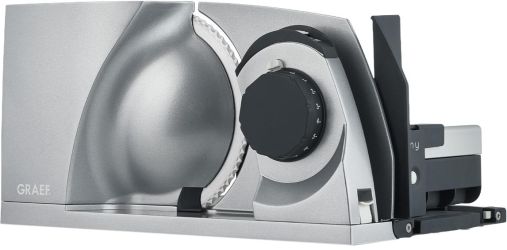
Most domestic slicers have an adjustable thickness control, commonly allowing slices from very thin through to roughly 15mm to 20mm, depending on the model. A precise, clearly marked dial is useful for producing even sandwich slices, wafer-thin cured meat or thicker cuts for cooking.
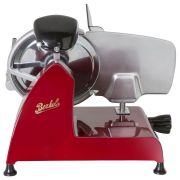
The food carriage should slide smoothly without wobbling. A food holder or finger guard is essential, as it keeps hands away from the blade and helps you slice smaller pieces safely. Some models use a tilted carriage, which allows food to move towards the blade with less effort; this can be useful for heavier items, but is not necessary for every kitchen.
Look for:
- Adjustable slice thickness with clear controls
- Smooth or serrated blade suitable for the foods you slice most
- Food holder, finger guard and stable carriage
- Non-slip feet or suction feet for a secure position on the worktop
- A tray to catch slices and crumbs
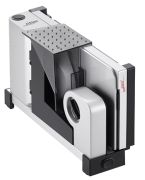
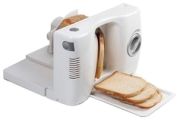
- Foldable or compact design if cupboard space is limited
- Easy access to compatible replacement blades
Safety features
Food slicers have exposed sharp blades, so safe operation should be the main buying consideration. Choose a model with a safety switch, child lock or momentary-operation control that stops the blade when the button is released. A blade guard and secure carriage are also important.
Place the slicer on a dry, stable worktop and keep the cable away from the cutting area. Never leave it running unattended, and unplug it before changing the blade, clearing trapped food or cleaning.
For households with children, store the appliance and any removable blade securely out of reach. A slicer should not be used by children unless they are old enough, closely supervised and the manufacturer specifically states that it is appropriate.
Construction, cleaning and storage
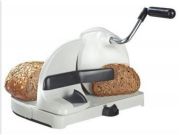
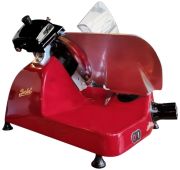
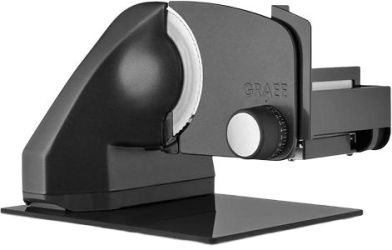
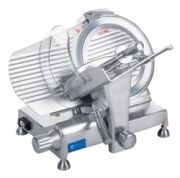
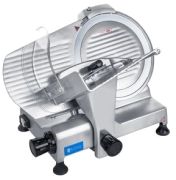
Plastic slicers are often lighter and more affordable, while metal-bodied models can provide greater stability and durability. A heavier base, non-slip feet and good build quality are particularly useful when slicing bread or firm foods.
Choose a model that can be dismantled enough for safe cleaning. The blade, food carriage, crumb tray and food holder may be removable, but cleaning instructions vary. Do not immerse the motor housing in water, and take particular care when handling blades.
After use, remove food residue promptly, dry all parts thoroughly and reassemble the slicer with the blade guard in place. Follow the manufacturer’s instructions on whether components are dishwasher-safe; frequent dishwasher use can affect some coatings and plastic parts.
Food slicer buying checklist
- Choose a blade size that suits the loaves and foods you slice.
- Select a smooth blade for cheese and cooked meat, or a serrated blade for crusty bread.
- Check whether replacement blades are available
- Look for precise slice-thickness adjustment.
- Prioritise a food holder, blade guard, safety switch and non-slip feet.
- Choose a stable metal-bodied model for frequent or heavy-duty home use.
- Check that key parts can be removed for safe cleaning.