


Top loaders: Consumer tips

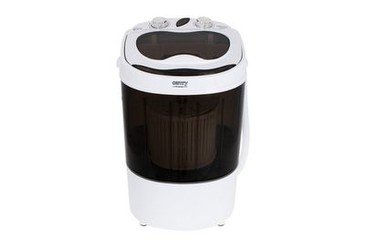
Not everyone has a laundry room available, or enough space in their flat to set up a large washing machine. A top loader provides a solution here and can be accommodated in small kitchens and bathrooms. Although front loaders dominate the market, there is a wide selection of different devices from manufacturers. With our consumer tips, we help with the selection of the new device.
What is a top loader?
A top loader is a washing machine where the laundry is loaded from above. Unlike a front loader, the top loader can be conveniently filled while standing, which not only protects the back but also prevents the floor from getting wet when removing the finished laundry. A top loader does not have a viewing window (porthole) due to its design. The biggest advantage is the compact design with a width of 40 or 45 cm. Many kitchens and bathrooms are so narrow that only a top loader is an option if you want to wash your own laundry. This design is especially worth considering for single-person households, as they typically generate less laundry, and thus the capacity of up to 7 kg is completely sufficient. Seniors also benefit from the back-friendly design.
Spin speed
The spin speed of a washing machine indicates how many times the drum rotates per minute. Depending on the programme, a different speed is used. The number of revolutions per minute ranges from 600 to 1,400. There are also machines with special night programmes where the machine does not spin. For clothing made from delicate fabrics like wool or silk, it is essential to wash with a low spin speed to avoid damaging the fibres and to enjoy the textiles for a long time. Special care is required for garments that should not be spun. In this case, the spin cycle must be completely turned off. Generally, the higher the revolutions of the washing machine, the drier the laundry, but the textiles are subjected to greater stress. A lower residual moisture saves energy during subsequent drying. To prevent the machine from moving during spinning, it must be properly aligned during installation and placed on a stable surface.
Energy efficiency
When purchasing a washing machine, water and electricity consumption play a crucial role, as there are hidden additional costs. Since March 2021, there are new labels that indicate energy and water consumption as well as the energy efficiency class. This allows consumers to compare devices more easily and ultimately save money. The most energy-efficient class is still A and goes up to G. However, the best class A will only be achieved by most washing machines over the next ten years, as the classes are designed this way. The 'Plus' classes have been completely eliminated. It is also new that every washing machine must now have the 'eco 40-60' programme. In this programme, normally soiled cotton laundry that can be washed at 40 °C or 60 °C can be cleaned together. Those who want to wash in an environmentally friendly and energy-saving way should choose the Eco programme. This uses the least water and energy. For quick wash cycles, there is the Speed function, which, however, consumes more energy.
Other features
Another criterion to consider is the noise level produced by the washing machine. This should not be too high, as the devices are in operation for several hours. Particularly quiet models achieve values of under 80 dB.
It is also advisable to have the so-called Aquastop, which prevents a larger water damage in the flat in case of a leak in the washing machine. If your washing machine does not have an Aquastop function, it can be mechanically retrofitted.
Top loaders offer the most common washing programmes such as pre-wash for heavy soiling, cotton and coloured washes, easy-care, wool, silk, delicate, and quick washes. In addition, many devices also have special washing programmes for outdoor clothing or lingerie, which operate with different washing temperatures and durations.