



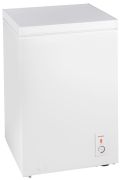


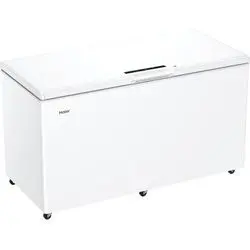


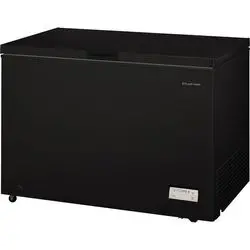


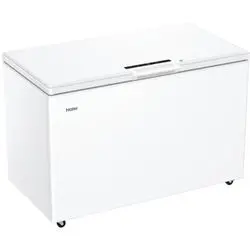




Chest Freezer: Consumer Tips

A chest freezer is always the optimal solution when a high storage volume is required. It impresses with its energy efficiency and relatively moderate purchase costs. When selecting a freezer, energy efficiency, power consumption, and the noise level of the appliance play a crucial role.
Chest freezer or freezer?
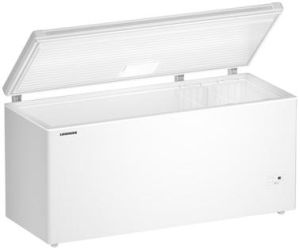
Chest freezers and freezers each have specific advantages and disadvantages that vary depending on individual needs. In terms of capacity, chest freezers offer significantly more storage space, especially for large or bulk quantities of food. Freezers allow for clearer storage through their drawers and compartments. Regarding design, chest freezers require more space, both in width and height for the lid that opens upwards, which is why they are usually placed in basements or storage rooms. Freezers, on the other hand, are often more compact and can be integrated into fitted kitchens. In terms of purchase costs, chest freezers are cheaper than comparable freezers, and they consume about 10-15% less electricity due to their design. This is because cold air is better retained in the chest, and the insulation is often thicker. In terms of features, chest freezers offer fewer additional functions: while freezers often come with features like ice makers and NoFrost technology as standard, chest freezers typically only offer basic functions like LowFrost or a quick-freeze mode.
How big should the chest freezer be?
The volume or capacity of cooling and freezing appliances is referred to as usable content. This is always stated in litres. The amount of required usable content depends on the size of the household and living conditions. For example, the number of people or the size of the household, as well as the extent of stockpiling, can determine the necessary space. Those who enjoy fishing or have a large vegetable garden will likely need more space in a chest freezer or freezer than if only weekly groceries are to be stored. For those who need few supplies, a requirement of about 30-50 litres per person should be calculated. If one wants to store a generous supply of frozen goods, one should expect about 100-130 litres per person. With a volume of 200 litres, you will be well advised in any case.
Save with a good energy efficiency class
According to legal regulations, all devices available on the market must be equipped with an energy label that indicates the relevant values. In 2021, a comprehensive revision of the label took place. Compared to its previous state, it is no longer comparable in terms of energy efficiency class and power consumption, as the classification system and the underlying calculation methods have changed. The following changes occur in the energy efficiency classes: the new scale ranges from class A, which indicates the highest efficiency, to class G, which indicates the lowest efficiency, thus replacing the previous classification from class A++ to class D. Classes A and B are considered below average in this context, as many model classes have been downgraded from class A to class C or D due to the modified measurement methods. The energy efficiency classes A to D were created to make room for new, particularly economical devices that are currently still in development. Therefore, efficient freezing devices can currently be found in energy efficiency classes A to D, while devices in class E are currently less recommended. The energy label indicates the annual power consumption of the device. This value cannot be compared with that of the old label. However, the correspondence of this value with the actual consumption of the device in daily operation depends on various factors, such as the placement of the device and its usage.
A chest freezer operates particularly energy-efficiently when placed in a suitable location. This should be dry, airy, and cool, and away from heat sources. Otherwise, not only can there be increased energy consumption, but also damage to the compressor may occur. Additionally, adequate ventilation for the chest freezer must be ensured, as it dissipates heat during the cooling process. The refrigerant in the piping system extracts heat from the interior, which is then released outside via the condenser. To avoid unnecessary energy costs, the storage temperature should be maintained at -18 °C, as lower temperatures are only necessary when freezing fresh food. Energy-saving functions or eco modes facilitate this setting. Proper handling also helps save electricity: warm foods should first be cooled, and the cold chain should be maintained while shopping. It is also important not to leave the lid open unnecessarily long and to regularly check the door seal, as leaks can lead to higher energy consumption. Finally, the chest freezer should be defrosted regularly – at the latest when an ice layer of 5 mm has formed. For LowFrost devices, this process is needed less frequently.
Noise level
The operating noise level of a chest freezer is indicated on the energy label and is classified into air sound emission classes from A to D. This classification provides information about the noise level of the device during operation. However, it is important to note that the noise level of chest freezers is less critical compared to other household appliances like refrigerators or fridge-freezer combinations, which are usually placed in living areas. Nevertheless, quiet operation can be significant if the freezer is located in adjacent rooms. Devices in classes A to C are classified as quiet: class A (up to 29 dB) corresponds to a whisper or breathing sound, while class B (30-35 dB) is comparable to quiet speaking. The noise level of class C is on par with that of a room fan, while class D, with a value of 42 dB, reaches the noise level of a television. For those who place particular importance on a quiet operation of the chest freezer, it is advisable to choose a model from the noise classes A to C.
Freezing capacity and storage time during power failure
Since chest freezers are usually not located in living areas but in the basement or garage, a failure may not be noticed immediately. Therefore, it is advisable to check the storage time before a disturbance. This refers to the time it takes for the temperature in the device to rise from -18 °C to -9 °C without power. This temperature is considered a critical threshold, beyond which food can still be consumed without concern. The storage time during a disturbance depends on the insulation of the device. For chest freezers that are particularly well insulated, the storage time ranges from 10 to 60 hours. If the chest freezer is frequently used for freezing fresh or already cooked foods, it is advisable to choose a device with a high freezing capacity. This value indicates how much fresh produce can be frozen through to the core within 24 hours.
Features
Chest freezers offer a variety of practical functions that enhance both comfort and safety in the household or business. An integrated door lock not only serves as security in commercial settings but can also be used as a mechanical child safety feature at home. An electronic child lock prevents important settings such as temperature or freezing mode from being accidentally changed at the push of a button. An LED light that automatically turns on and off provides better visibility inside. Some models are equipped with wheels that make moving easier, as a full chest freezer is very heavy. For an organised storage of small items like herbs, baskets are available, which may be included by the manufacturer or sold separately. The LowFrost technology significantly reduces ice formation, so defrosting is needed less frequently, and the temperature is maintained more evenly through special cooling lines or smooth interior walls. The quick-freeze function allows larger quantities of food to be frozen quickly by temporarily increasing the freezing capacity. This may lead to an increase in power consumption and noise development, but an automatic shut-off usually ensures efficient use. Additional safety is provided by models equipped with a door alarm that sounds if the door is left open for too long. A temperature alarm indicates a sudden rise in temperature – whether due to warm foods, a power failure, or a defect. All these functions contribute to making the use of a chest freezer more comfortable, efficient, and safe.
